
Are eSignatures Legally Valid? India, US & EU Laws Explained


In a world where business is done at digital pace, the wait for someone to print, sign, scan and send a document seems like a step backward. Electronic signatures also known as eSignatures have transformed the way agreements are executed. But one question still comes up regularly,
Are eSignatures legally valid?
The answer depends on what laws apply where you sign. Electronic signatures are accepted and legally binding in India, the United States and the European Union (EU), subject to compliance with certain rules / standards. This blog explains the legal frameworks in these regions so you know exactly when electronic signatures carry legal weight and when they might not.
What Does “Legally Valid” Mean for eSignatures?
Before discussing specific laws, it is helpful to know what “legally valid” means. A legally valid eSignature means,
- The signatory’s intent to sign is clear
- The identity of the signer can be verified
- The document cannot be altered after signing
- The signature can be used as evidence in court if needed
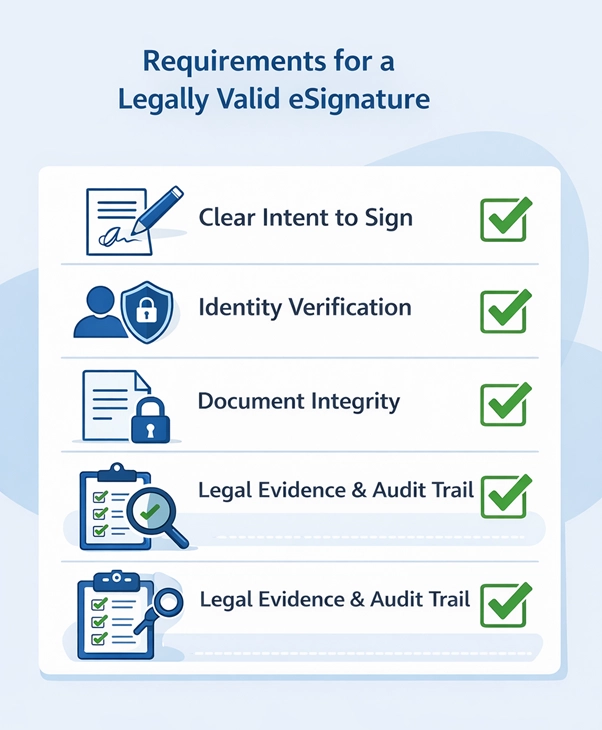
Just because you type a name on a document doesn’t mean it’s legally binding. The most important thing is that the signature complies with the local legal requirements, and that it can be proven if the signature is challenged in the future.
Legal Validity of eSignatures in India
Yes, eSignatures are legally valid and recognized in India under the IT Act, 2000 (the “IT Act”). The Act also states that in certain circumstances electronic records and electronic signatures shall be treated as written documents and traditional signatures.
Legal Basis in India
The IT Act, 2000 and related rules establish the legal foundation for electronic signatures in India. Under this framework,
- An electronic signature must clearly link to the signatory
- It must be under the exclusive control of the signer
- Changes after signing must be detectable
- An audit trail must demonstrate when and how the signature was applied
What Counts as an eSignature in India?
India supports different variants of eSign including click-to-sign, Aadhaar-based eSign and certificate based digital signature issued by licensed Certifying Authorities (CAs). For instance, under Aadhaar eSign, it is possible for a person to sign by authenticating via OTP or biometric modes linked to their unique Aadhaar identity.
Practical Use and Exceptions
In everyday business, eSignatures are widely accepted for,
However, certain documents are not capable of being signed electronically in India. These are wills, trusts, powers of attorney, and sale deeds of property, etc.
Legal Evidence in India
Indian courts consider eSigned Documents as evidence if the digital signature fulfills the legal requirements. In this regard, under the Evidence Act, the courts may even take the authenticity of a secure electronic signature to be proved unless the contrary is established, which gives further legal assurance to compliant eSignatures.
In short: Legally valid eSignatures in India are binding on business and personal transactions in the majority of cases, provided that the signing procedure is secure and compliant.
Legal Validity of eSignatures in US
Yes, eSignatures are legally binding in the US. There are two major laws that make this possible – the Electronic Signatures in Global and National Commerce (ESIGN) Act, and the Uniform Electronic Transactions Act (UETA).
ESIGN Act (Federal Law)
The ESIGN Act, passed in 2000, is a federal statute that states that electronic records and electronic signatures shall not be denied legal effect or validity on the basis of being in electronic form for certain application, including transactions involving in interstate commerce or foreign commerce.
UETA (State-Level Law)
Most US states have adopted the UETA, which further supports the legal validity of eSignatures at a local level. The act ensures that:
- Electronic signatures satisfy requirements for signature in contracts
- Electronic records satisfy requirements for written documents
- Contracts can be formed electronically with legal enforceability
How eSignatures Are Used in the US?
In the US, electronic signatures are valid across all industries, including HR onboarding forms, sales contracts, and vendor agreements. Such things as the consent to transact electronically and a reliable association between the signature and the signer are important for legal enforceability.
There are exceptions, such as some court orders, wills and adoption documents, which may still require pen and paper but these are very specific and few.
In short: Legally valid eSignatures in the US hold the same weight as the handwritten signatures if the signing complies with the provisions of ESIGN and UETA.
Legal Validity of eSignatures in EU
Yes, eSignatures have legal validity in the EU under eIDAS Regulation (Regulation (EU) No 910/2014). This legislation creates an equal treatment/equal access legal environment for electronic signatures within the EU.
How eIDAS Recognizes eSignatures?
The legal effect and the admissibility of an electronic signature in a legal proceeding shall not be denied solely because it is in electronic form (Article 25 eIDAS). This implies that simple and advanced types of electronic signatures can ordinarily be accepted as evidence in courts of law.
eIDAS establishes three levels of electronic signatures,
- Simple Electronic Signature (SES): Simple formatting, like typing names or clicking to sign.
- Advanced Electronic Signature (AES): Should bind the signer to the signature in a unique manner and should not allow any undetected changes
- Qualified Electronic Signature (QES): Top level, created with the use of a qualified certificate and has the same legal effect as a handwritten signature in all EU Member States
Mutual Recognition Across EU
One of the strengths of eIDAS is mutual recognition. A certified electronic signature issued in one member state of the EU is recognized in all other member states.
Practical Impact
This framework eliminates legal uncertainty and allows cross-border digital transactions in the EU. Several companies rely on advanced or qualified signatures for large value contracts, to ensure enforceability and compliance with sectoral regulation.
In short: In the EU, eSignatures that are compliant with eIDAS can be considered legally binding. Qualified electronic signatures have the same legal value as a handwritten signature on a paper.
Where eSignatures Are Not Legally Accepted?
While eSignatures are generally accepted, there are some documents that are not eligible. The execution of electronic signing has been limited in a number of countries for documents relating to inheritance, long-term rights, or those which pose a significant legal risk. This is mainly because these documents require stronger proof of intent, physical presence, and independent verification, which basic electronic signing cannot always guarantee.
Across India, the US, and the EU, eSignatures are generally not permitted for:
- Wills and testamentary instruments, in which the intent must be proved to the satisfaction of the court
- Trust deeds and certain fiduciary documents, that provide long-term control of assets and responsibilities
- Adoption and guardianship documents, in so far as they relate to the personal status and the rights of minors
- Court orders and notices, which adhere to rigorous judicial protocols
- Deeds to real property and documents transferring property, as they have a permanent effect and usually need to be witnessed or registered
These documents must often be signed in person, witnessed or notarized to minimize disputes and enhance the legal certainty. For the sensitive or high value transactions, it is always advisable to check the local legal requirements before use of eSignatures.
Key Legal Differences Across India, US, and EU
| Region | Law/Regulation | Legal Status of eSignatures | Notes |
|---|---|---|---|
| India | IT Act, 2000 | eSignatures legally binding | Exceptions for wills, property deeds, etc. |
| US | ESIGN Act & UETA | eSignatures legally enforceable | Applies in interstate and local transactions |
| EU | eIDAS Regulation | eSignatures legally valid | QES equals handwritten signatures |
Final Thoughts
Electronic signatures are not futuristic anymore. They are legally allowed and enforceable in India, US and EU, if they comply with the local law requirements.
- In India, eSignatures legally valid under the IT Act contribute to faster business and government processes.
- In the US, the legal effect of eSignatures is guaranteed by federal and state laws.
- In the EU, eIDAS ensures a uniform standard of legal acceptance in all member states.
Whether a business is signing contracts with local partners or entering international agreements, understanding these laws helps ensure that agreements are not only efficient but also legally secure.
Sign up for Free
Trial today!
Try KAiZEN for free

In a world where business is done at digital pace, the wait for someone to print, sign, scan and send a document seems like a step backward. Electronic signatures also known as eSignatures have transformed the way agreements are executed. But one question still comes up regularly,
Are eSignatures legally valid?
The answer depends on what laws apply where you sign. Electronic signatures are accepted and legally binding in India, the United States and the European Union (EU), subject to compliance with certain rules / standards. This blog explains the legal frameworks in these regions so you know exactly when electronic signatures carry legal weight and when they might not.
What Does “Legally Valid” Mean for eSignatures?
Before discussing specific laws, it is helpful to know what “legally valid” means. A legally valid eSignature means,
- The signatory’s intent to sign is clear
- The identity of the signer can be verified
- The document cannot be altered after signing
- The signature can be used as evidence in court if needed
Just because you type a name on a document doesn’t mean it’s legally binding. The most important thing is that the signature complies with the local legal requirements, and that it can be proven if the signature is challenged in the future.
Legal Validity of eSignatures in India
Yes, eSignatures are legally valid and recognized in India under the IT Act, 2000 (the “IT Act”). The Act also states that in certain circumstances electronic records and electronic signatures shall be treated as written documents and traditional signatures.
Legal Basis in India
The IT Act, 2000 and related rules establish the legal foundation for electronic signatures in India. Under this framework,
- An electronic signature must clearly link to the signatory
- It must be under the exclusive control of the signer
- Changes after signing must be detectable
- An audit trail must demonstrate when and how the signature was applied
What Counts as an eSignature in India?
India supports different variants of eSign including click-to-sign, Aadhaar-based eSign and certificate based digital signature issued by licensed Certifying Authorities (CAs). For instance, under Aadhaar eSign, it is possible for a person to sign by authenticating via OTP or biometric modes linked to their unique Aadhaar identity.
Practical Use and Exceptions
In everyday business, eSignatures are widely accepted for,
However, certain documents are not capable of being signed electronically in India. These are wills, trusts, powers of attorney, and sale deeds of property, etc.
Legal Evidence in India
Indian courts consider eSigned Documents as evidence if the digital signature fulfills the legal requirements. In this regard, under the Evidence Act, the courts may even take the authenticity of a secure electronic signature to be proved unless the contrary is established, which gives further legal assurance to compliant eSignatures.
In short: Legally valid eSignatures in India are binding on business and personal transactions in the majority of cases, provided that the signing procedure is secure and compliant.
Legal Validity of eSignatures in US
Yes, eSignatures are legally binding in the US. There are two major laws that make this possible – the Electronic Signatures in Global and National Commerce (ESIGN) Act, and the Uniform Electronic Transactions Act (UETA).
ESIGN Act (Federal Law)
The ESIGN Act, passed in 2000, is a federal statute that states that electronic records and electronic signatures shall not be denied legal effect or validity on the basis of being in electronic form for certain application, including transactions involving in interstate commerce or foreign commerce.
UETA (State-Level Law)
Most US states have adopted the UETA, which further supports the legal validity of eSignatures at a local level. The act ensures that:
- Electronic signatures satisfy requirements for signature in contracts
- Electronic records satisfy requirements for written documents
- Contracts can be formed electronically with legal enforceability
How eSignatures Are Used in the US?
In the US, electronic signatures are valid across all industries, including HR onboarding forms, sales contracts, and vendor agreements. Such things as the consent to transact electronically and a reliable association between the signature and the signer are important for legal enforceability.
There are exceptions, such as some court orders, wills and adoption documents, which may still require pen and paper but these are very specific and few.
In short: Legally valid eSignatures in the US hold the same weight as the handwritten signatures if the signing complies with the provisions of ESIGN and UETA.
Legal Validity of eSignatures in EU
Yes, eSignatures have legal validity in the EU under eIDAS Regulation (Regulation (EU) No 910/2014). This legislation creates an equal treatment/equal access legal environment for electronic signatures within the EU.
How eIDAS Recognizes eSignatures?
The legal effect and the admissibility of an electronic signature in a legal proceeding shall not be denied solely because it is in electronic form (Article 25 eIDAS). This implies that simple and advanced types of electronic signatures can ordinarily be accepted as evidence in courts of law.
eIDAS establishes three levels of electronic signatures,
- Simple Electronic Signature (SES): Simple formatting, like typing names or clicking to sign.
- Advanced Electronic Signature (AES): Should bind the signer to the signature in a unique manner and should not allow any undetected changes
- Qualified Electronic Signature (QES): Top level, created with the use of a qualified certificate and has the same legal effect as a handwritten signature in all EU Member States
Mutual Recognition Across EU
One of the strengths of eIDAS is mutual recognition. A certified electronic signature issued in one member state of the EU is recognized in all other member states.
Practical Impact
This framework eliminates legal uncertainty and allows cross-border digital transactions in the EU. Several companies rely on advanced or qualified signatures for large value contracts, to ensure enforceability and compliance with sectoral regulation.
In short: In the EU, eSignatures that are compliant with eIDAS can be considered legally binding. Qualified electronic signatures have the same legal value as a handwritten signature on a paper.
Where eSignatures Are Not Legally Accepted?
While eSignatures are generally accepted, there are some documents that are not eligible. The execution of electronic signing has been limited in a number of countries for documents relating to inheritance, long-term rights, or those which pose a significant legal risk. This is mainly because these documents require stronger proof of intent, physical presence, and independent verification, which basic electronic signing cannot always guarantee.
Across India, the US, and the EU, eSignatures are generally not permitted for:
- Wills and testamentary instruments, in which the intent must be proved to the satisfaction of the court
- Trust deeds and certain fiduciary documents, that provide long-term control of assets and responsibilities
- Adoption and guardianship documents, in so far as they relate to the personal status and the rights of minors
- Court orders and notices, which adhere to rigorous judicial protocols
- Deeds to real property and documents transferring property, as they have a permanent effect and usually need to be witnessed or registered
These documents must often be signed in person, witnessed or notarized to minimize disputes and enhance the legal certainty. For the sensitive or high value transactions, it is always advisable to check the local legal requirements before use of eSignatures.
Key Legal Differences Across India, US, and EU
| Region | Law/Regulation | Legal Status of eSignatures | Notes |
|---|---|---|---|
| India | IT Act, 2000 | eSignatures legally binding | Exceptions for wills, property deeds, etc. |
| US | ESIGN Act & UETA | eSignatures legally enforceable | Applies in interstate and local transactions |
| EU | eIDAS Regulation | eSignatures legally valid | QES equals handwritten signatures |
Final Thoughts
Electronic signatures are not futuristic anymore. They are legally allowed and enforceable in India, US and EU, if they comply with the local law requirements.
- In India, eSignatures legally valid under the IT Act contribute to faster business and government processes.
- In the US, the legal effect of eSignatures is guaranteed by federal and state laws.
- In the EU, eIDAS ensures a uniform standard of legal acceptance in all member states.
Whether a business is signing contracts with local partners or entering international agreements, understanding these laws helps ensure that agreements are not only efficient but also legally secure.
Sign up for Free
Trial today!
Try KAiZEN for free