
SaaS Contracts Explained: NDA, DPA, MSA & Easy Way to Sign Them
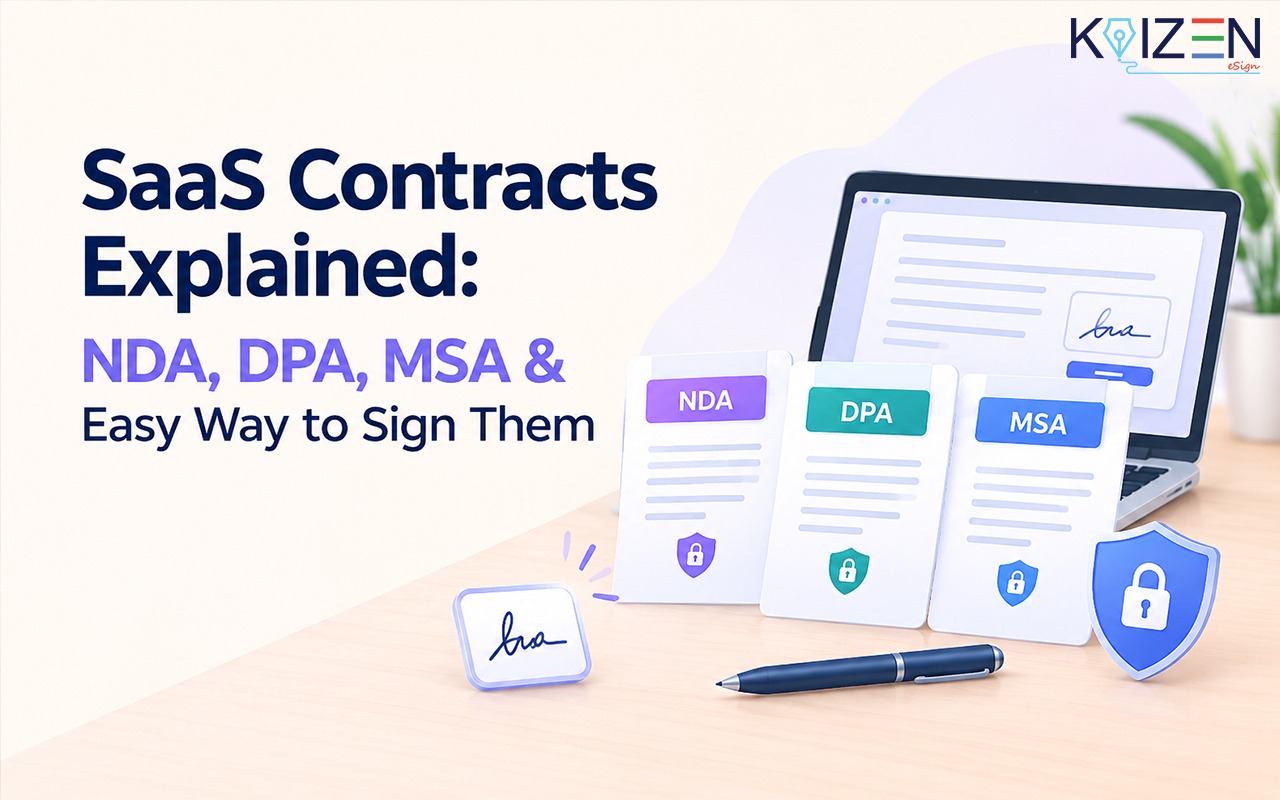
Do you sometimes feel confused and worried when a contract is sent to you for signature? Do you think you are the only person feeling this way? This feeling is very common, especially with business people.
There are lots of papers like the Non-Disclosure Agreement (NDA), the Data Processing Agreement (DPA) and the Master Services Agreement (MSA) and other equally ‘scary’ looking contracts. Many people have to sign these contracts and unfortunately, most people sign these contracts without understanding their meaning or what they are actually agreeing to.
This document will show you what these contracts mean, what you should look out for before signing, and how to quickly and securely sign them online.
What Is a SaaS Contract?
SaaS contracts outline legal terms for a customer who is using a web application. The terms defines the legal limits for the customer, the web application provider, and for any liability.
Imagine that a customer wants to rent a bike from a friend. In order for the friend to allow renting of his bike, there have to be agreed upon terms for the bike rental (for example, how long the bike can be rented, who will be liable in case the bike is damaged and to what extent will the liable party be, etc.). Like in the example, terms for a legal agreement have been arrived at and captured in a legal document. SaaS agreements are based on preceding agreements (NDAs, DPAs and MSAs).
Why Contracts Feel So Slow
Here is what often happens. You find a great software tool and want to start today. Then the trouble begins.
Someone emails you a contract. You print it, sign it, and scan it. The scan is blurry, so you send it again. The other person is travelling and cannot sign until next week. Now your whole project is stuck.
Slow signing wastes days, and sometimes it even loses the deal. Later in this guide, you will see a much easier way. First, let’s meet the three contracts.
What is NDAs (Non-Disclosure Agreements)
You tell your best friend your secret because you know they can be trusted not to tell others. But what if you could take your trust and turn it into something more official? Something like an NDA?
An NDA is something that allows you to be trustworthy with someone else’s secret. When a company wants to partner with another company, there are a lot of confidential things about the other company that they do not want the public to know. Things like what are their strategies? Or what are their plans? Maybe even what their prices are? Or what are their customers’ names? These things are protected with an NDA. An NDA states “I will not disclose your confidential information to anybody.”
In addition, a good NDA states:
- For how long will the information be protected? (generally from 1 to 5 years)
- What will happen if the NDA is breached?(generally the other party will be entitled to an injunction to restrain breach, and/or damages)
- What is the purpose of the NDA? (Protects information that is given to the other party to help in negotiating and/or forming the agreement)
An NDA is generally signed when a new invention is made and the creator wants to keep their idea confidential. Usually an NDA is signed by both parties. In some situations, one of the parties signs the NDA to protect their idea.
What Is a DPA (Data Processing Agreement)?
You keep your friends’ diaries. You don’t photocopy them and share them. You keep them private and give them back when your friend asks for them.
It’s similar for data. There is something called a Data Protection Agreement (DPA) that says you will protect your customers’ data and keep it private.
There are many rules about data, like the General Data Protection Regulation (GDPR) and the Data Protection Act 2022 of India. They say you can’t have other people’s data unless you have an agreement. A DPA is that agreement.
A good DPA gives you the answers to several questions. These include:
- What kind of data will be processed?
- For what purposes will the data be processed?
- What kind of safeguards will be implemented?
- Who will be involved in the processing of the data?
- Will the data be transferred to other countries?
- What will happen to the data when the processing ends?
- Will the data be deleted?
You allow your friend to enter your home to perform a specific task, but that doesn’t allow your friend to give a key to others to enter your home. Likewise, your friend can’t make copies of your key. A DPA states the same about your data.
What Is an MSA (Master Service Agreement)?
Board Games are a great analogy for the type of work we will be doing for this assignment. Before you start playing a board game, the rules must be explained to all the players. Once the rules are learned, frequent explanations of the rules are not required to play the game. This saves a lot of time and can be applied to business scenarios.
An MSA is a business contract that represents the “rule book” for a business agreement. Like a rule book for a board game, a MSA states the rules of the game for the agreement between the two businesses. A MSA contains:
- The name of the service provided by each business
- The monetary value for the service and the due date for payment
- The time period for which the service is provided
- The standards or levels of service provided by each business
- Who is responsible for a service if it is not provided to the level agreed upon
- The terms for withdrawal from the agreement
The term “master” in MSA refers to the “rule book” or contract that governs the agreement between the two businesses. A MSA is signed first, and then other agreements that govern specific projects between the two businesses may be executed. Similar to a board game, the MSA is the rule book, and projects are rounds of game play.
How the Three Contracts Fit Together
| Contract | What It Protects | Simple Job | Usually Signed |
| NDA | Secrets | “Don’t tell anyone” | First, while talking |
| DPA | Customer data | “Keep data safe” | Before data is shared |
| MSA | The whole deal | “Here are our main rules” | When the deal begins |
An easy way to remember the order: sign the NDA first, so both sides can talk freely. Then sign the MSA to set the main rules, and the DPA alongside it to protect data before any is shared.
What to Check Before You Sign
Signing is a big step, so take a moment first. Ask yourself:
- Do I understand what I am promising? If not, ask questions or talk to a lawyer.
- Are the names, dates, and numbers right?
- How long does the promise last?
- What happens if I want to leave?
- Is my data handled safely?
- Will I get a final signed copy?
Read the parts about money, time, and what happens if something goes wrong twice. These are the parts people miss most often.
Some mistakes are also very common. People sign without reading. They share secrets before the NDA is signed. They skip the DPA even when they handle customer data. They lose the signed copy in a pile of emails. And some sign in an unsafe way, like pasting a picture of a signature onto a PDF, which is easy to fake and weak as proof.
That last one leads us to the easy fix.
Signing Documents Electronically: eSignature
An electronic signature, or eSignature, is a digital representation of a person’s signature. It is used to create signatures on documents without the use of pen and paper. Traditional signatures do not need to be printed, scanned, faxed, or mailed.
Many eSignature services do not guarantee that a document will be signed by the correct individual, or that the document will be protected from unauthorized changes. Some eSignature services may not comply with the laws of a given country. Furthermore, some eSignature services may not protect signed documents or provide evidence of when a document was signed.
KAiZEN eSign provides a web-based eSignature service. The service meets the requirements of the standards and regulations DSC, eIDAS, and AATL. The service provides features that encrypt signed documents and provide evidence of when a document was signed. The service may be used by individuals and businesses of all sizes. The service may be used on computers, smart phones, and tablets.
To use the service, you must upload a document and indicate the location of signature for each individual. Once all signature locations are filled, the document is considered signed and a copy is automatically forwarded to the individuals who signed it.
Conclusion
While NDAs, DPAs and MSAs may appear complicated, they are really just easy to understand agreements.
- An NDA is just an agreement to keep someone else’s information confidential.
- A DPA is just an agreement to secure someone else’s information.
- An MSA is just a summary of the general business terms for collaborating with another party.
Know the terms of each of these agreements and other agreement types. Identify the important parts of each agreement. Use a trusted eSignature service to electronically sign agreements to ensure that the agreements are valid and enforceable.
Frequently Asked Questions
2. Which contract should be signed first?
Usually the NDA, because it lets both sides share ideas safely. The MSA and DPA come after that.
3. Do small businesses need a DPA?
Yes, if they handle personal data like names, emails, or phone numbers. Data protection laws apply to small businesses too.
4. Can I sign an NDA, DPA, or MSA electronically?
Yes, In many countries, eSignatures are legally valid for these contracts. It is best to use a tool that follows recognized standards like eIDAS and AATL.
5. Who should sign these contracts?
Someone with the power to make promises for the company, like an owner, a director, a manager, or a legal team member.
Table of Contents
- What Is a SaaS Contract?
- Why Contracts Feel So Slow
- What is NDAs (Non-Disclosure Agreements)
- What Is a DPA (Data Processing Agreement)?
- What Is an MSA (Master Service Agreement)?
- How the Three Contracts Fit Together
- What to Check Before You Sign
- Signing Documents Electronically: eSignature
- Conclusion
- Frequently Asked Questions
Sign up for Free
Trial today!
Try KAiZEN for free

Do you sometimes feel confused and worried when a contract is sent to you for signature? Do you think you are the only person feeling this way? This feeling is very common, especially with business people.
There are lots of papers like the Non-Disclosure Agreement (NDA), the Data Processing Agreement (DPA) and the Master Services Agreement (MSA) and other equally ‘scary’ looking contracts. Many people have to sign these contracts and unfortunately, most people sign these contracts without understanding their meaning or what they are actually agreeing to.
This document will show you what these contracts mean, what you should look out for before signing, and how to quickly and securely sign them online.
What Is a SaaS Contract?
SaaS contracts outline legal terms for a customer who is using a web application. The terms defines the legal limits for the customer, the web application provider, and for any liability.
Imagine that a customer wants to rent a bike from a friend. In order for the friend to allow renting of his bike, there have to be agreed upon terms for the bike rental (for example, how long the bike can be rented, who will be liable in case the bike is damaged and to what extent will the liable party be, etc.). Like in the example, terms for a legal agreement have been arrived at and captured in a legal document. SaaS agreements are based on preceding agreements (NDAs, DPAs and MSAs).
Why Contracts Feel So Slow
Here is what often happens. You find a great software tool and want to start today. Then the trouble begins.
Someone emails you a contract. You print it, sign it, and scan it. The scan is blurry, so you send it again. The other person is travelling and cannot sign until next week. Now your whole project is stuck.
Slow signing wastes days, and sometimes it even loses the deal. Later in this guide, you will see a much easier way. First, let’s meet the three contracts.
What is NDAs (Non-Disclosure Agreements)
You tell your best friend your secret because you know they can be trusted not to tell others. But what if you could take your trust and turn it into something more official? Something like an NDA?
An NDA is something that allows you to be trustworthy with someone else’s secret. When a company wants to partner with another company, there are a lot of confidential things about the other company that they do not want the public to know. Things like what are their strategies? Or what are their plans? Maybe even what their prices are? Or what are their customers’ names? These things are protected with an NDA. An NDA states “I will not disclose your confidential information to anybody.”
In addition, a good NDA states:
- For how long will the information be protected? (generally from 1 to 5 years)
- What will happen if the NDA is breached?(generally the other party will be entitled to an injunction to restrain breach, and/or damages)
- What is the purpose of the NDA? (Protects information that is given to the other party to help in negotiating and/or forming the agreement)
An NDA is generally signed when a new invention is made and the creator wants to keep their idea confidential. Usually an NDA is signed by both parties. In some situations, one of the parties signs the NDA to protect their idea.
What Is a DPA (Data Processing Agreement)?
You keep your friends’ diaries. You don’t photocopy them and share them. You keep them private and give them back when your friend asks for them.
It’s similar for data. There is something called a Data Protection Agreement (DPA) that says you will protect your customers’ data and keep it private.
There are many rules about data, like the General Data Protection Regulation (GDPR) and the Data Protection Act 2022 of India. They say you can’t have other people’s data unless you have an agreement. A DPA is that agreement.
A good DPA gives you the answers to several questions. These include:
- What kind of data will be processed?
- For what purposes will the data be processed?
- What kind of safeguards will be implemented?
- Who will be involved in the processing of the data?
- Will the data be transferred to other countries?
- What will happen to the data when the processing ends?
- Will the data be deleted?
You allow your friend to enter your home to perform a specific task, but that doesn’t allow your friend to give a key to others to enter your home. Likewise, your friend can’t make copies of your key. A DPA states the same about your data.
What Is an MSA (Master Service Agreement)?
Board Games are a great analogy for the type of work we will be doing for this assignment. Before you start playing a board game, the rules must be explained to all the players. Once the rules are learned, frequent explanations of the rules are not required to play the game. This saves a lot of time and can be applied to business scenarios.
An MSA is a business contract that represents the “rule book” for a business agreement. Like a rule book for a board game, a MSA states the rules of the game for the agreement between the two businesses. A MSA contains:
- The name of the service provided by each business
- The monetary value for the service and the due date for payment
- The time period for which the service is provided
- The standards or levels of service provided by each business
- Who is responsible for a service if it is not provided to the level agreed upon
- The terms for withdrawal from the agreement
The term “master” in MSA refers to the “rule book” or contract that governs the agreement between the two businesses. A MSA is signed first, and then other agreements that govern specific projects between the two businesses may be executed. Similar to a board game, the MSA is the rule book, and projects are rounds of game play.
How the Three Contracts Fit Together
| Contract | What It Protects | Simple Job | Usually Signed |
| NDA | Secrets | “Don’t tell anyone” | First, while talking |
| DPA | Customer data | “Keep data safe” | Before data is shared |
| MSA | The whole deal | “Here are our main rules” | When the deal begins |
An easy way to remember the order: sign the NDA first, so both sides can talk freely. Then sign the MSA to set the main rules, and the DPA alongside it to protect data before any is shared.
What to Check Before You Sign
Signing is a big step, so take a moment first. Ask yourself:
- Do I understand what I am promising? If not, ask questions or talk to a lawyer.
- Are the names, dates, and numbers right?
- How long does the promise last?
- What happens if I want to leave?
- Is my data handled safely?
- Will I get a final signed copy?
Read the parts about money, time, and what happens if something goes wrong twice. These are the parts people miss most often.
Some mistakes are also very common. People sign without reading. They share secrets before the NDA is signed. They skip the DPA even when they handle customer data. They lose the signed copy in a pile of emails. And some sign in an unsafe way, like pasting a picture of a signature onto a PDF, which is easy to fake and weak as proof.
That last one leads us to the easy fix.
Signing Documents Electronically: eSignature
An electronic signature, or eSignature, is a digital representation of a person’s signature. It is used to create signatures on documents without the use of pen and paper. Traditional signatures do not need to be printed, scanned, faxed, or mailed.
Many eSignature services do not guarantee that a document will be signed by the correct individual, or that the document will be protected from unauthorized changes. Some eSignature services may not comply with the laws of a given country. Furthermore, some eSignature services may not protect signed documents or provide evidence of when a document was signed.
KAiZEN eSign provides a web-based eSignature service. The service meets the requirements of the standards and regulations DSC, eIDAS, and AATL. The service provides features that encrypt signed documents and provide evidence of when a document was signed. The service may be used by individuals and businesses of all sizes. The service may be used on computers, smart phones, and tablets.
To use the service, you must upload a document and indicate the location of signature for each individual. Once all signature locations are filled, the document is considered signed and a copy is automatically forwarded to the individuals who signed it.
Conclusion
While NDAs, DPAs and MSAs may appear complicated, they are really just easy to understand agreements.
- An NDA is just an agreement to keep someone else’s information confidential.
- A DPA is just an agreement to secure someone else’s information.
- An MSA is just a summary of the general business terms for collaborating with another party.
Know the terms of each of these agreements and other agreement types. Identify the important parts of each agreement. Use a trusted eSignature service to electronically sign agreements to ensure that the agreements are valid and enforceable.
Frequently Asked Questions
2. Which contract should be signed first?
Usually the NDA, because it lets both sides share ideas safely. The MSA and DPA come after that.
3. Do small businesses need a DPA?
Yes, if they handle personal data like names, emails, or phone numbers. Data protection laws apply to small businesses too.
4. Can I sign an NDA, DPA, or MSA electronically?
Yes, In many countries, eSignatures are legally valid for these contracts. It is best to use a tool that follows recognized standards like eIDAS and AATL.
5. Who should sign these contracts?
Someone with the power to make promises for the company, like an owner, a director, a manager, or a legal team member.
Sign up for Free
Trial today!
Try KAiZEN for free