
eSignature vs Wet Signature: Cost, Speed, Security and Business Impact
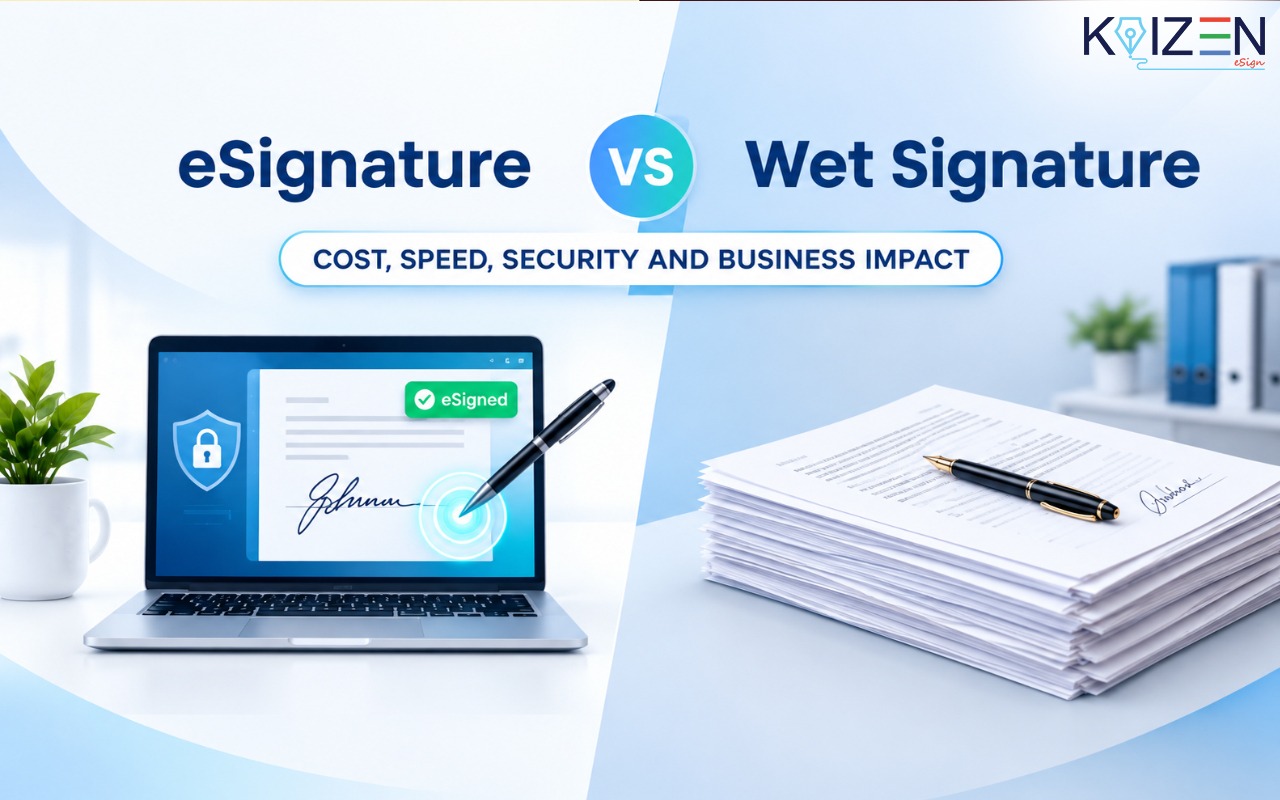

Signing documents is a common part of every business. Contracts, offer letters, agreements, and other important documents often need a signature before the work can move forward. With a wet signature, this usually means printing the document, signing it, scanning or sending it, and then storing the signed copy. An eSignature lets you complete the same process online. You can send a document, get it signed, and keep a digital record without dealing with printing, scanning, or couriering. This can make the signing process faster, easier, and more convenient for businesses.
So, let’s see how eSignatures and wet signatures compare when it comes to cost, speed, security, and business impact? Let’s look at the key differences between eSignature vs Wet Signature.
The Signature Was Never Really the Problem
Think about the last contract that took a week to close. Chances are nobody was dragging their feet on purpose. The client wanted to sign. Your team wanted it signed. It just sat there printed, waiting for someone to be in the office, waiting for a courier, waiting for a scan that came out blurry the first time.
That’s the thing about wet signatures that’s easy to miss: the actual signing takes ten seconds. Everything around it, printing, mailing, chasing, re-doing, is where the time goes. And once a document is out of your hands and in a courier bag, you’ve basically lost visibility into it until it comes back.
eSignatures don’t get rid of the signature. They get rid of the distance between the document and the person who needs to sign it. Once you strip that distance out, cost, speed, and risk all move at the same time, not because any one feature is doing the work, but because you’ve removed the thing that was causing all three problems.
eSignature vs Wet Signatures: Cost Comparison
Paper is cheap. That’s exactly why nobody tracks it, a ream of paper and a box of pens don’t look like a line item worth worrying about. But multiply that across every contract, offer letter, and vendor form a business sign in a year, and add courier fees for anything crossing cities, plus the storage cost of keeping signed originals for however many years compliance requires, and it stops being nothing. It’s just a cost that hides well.
eSignatures move that cost somewhere you can actually see it. Most platforms charge per signature or per user, so the bill tracks how much business you’re doing rather than how many filing cabinets you own. That’s a more honest number, and it’s one you can plan around.
The part that actually saves money, though, isn’t the paper you’re not buying, it’s the redo you’re not doing. A wet-signed form that comes back with a blank field or a wrong date has to go through the whole cycle again: reprint, resend, rewait. And usually nobody notices until it’s already too late to fix quickly. Digital signing catches that at the moment of signing, before the document is even marked complete.
eSignature vs Wet Signatures: Speed
A physical signature has to travel. Print it, sign it, scan it, email it, and if there’s a second signatory somewhere else, do most of that again in reverse. Even when everyone’s responsive and nothing goes wrong, that’s two or three days. Put the second signer in another city, and a week isn’t unusual, not because anyone’s slow, just because paper moves at the speed of people carrying it around.
Take the paper out, and that whole loop happens inside one screen. The document goes out, gets opened, gets signed, comes back, no scanner, no “did that email even send,” no second round because a signature landed on the wrong line. Documents needing several signatures can be set up in order too: your reviewer signs first, then the client, then whoever needs to countersign, and each person only sees it once it’s actually their turn.
What that buys you isn’t just convenience. A contract that closes the same afternoon instead of drifting for a week is a contract that doesn’t quietly die in someone’s inbox while a competitor gets there first.
eSignature vs Wet Signatures: Security
eSignature vs Wet Signature Which one is secure?
Cost and speed are about convenience. This part is about whether a signature can be trusted when someone actually questions it, in a dispute, an audit, a courtroom.
Here’s an uncomfortable truth about wet signatures: on their own, they don’t prove much. They can be copied with a bit of practice, and once ink is on paper, there’s no record of when it was signed, whether it’s the final version of the document, or whether a page got swapped out afterward. If two copies of a contract show up with conflicting terms, proving which one is real can turn into a genuinely difficult argument.
A proper eSignature carries its own proof. Who signed, from where, at what exact time, what they clicked and when, all logged automatically, baked into the document rather than living in someone’s memory. In India, a signature built on a DSC Class III certificate with AATL backing holds the same legal standing as a handwritten one under the IT Act, 2000, and can be checked instantly in Adobe Acrobat, nobody has to just take your word for it.
Then there’s the part people forget to worry about: encryption. A wet-signed document with salary details or commercial terms is only as safe as the email it gets attached to. A document that’s encrypted from the moment it’s uploaded to the moment it’s signed never spends time sitting unprotected in a Sent folder.
The Real Business Impact of eSignature and Wet Signatures
Lower cost, faster turnaround, better proof, those are easy to list. What’s harder to see until you’ve actually switched is how much of the business was quietly organized around waiting for paper.
Deals stop stalling for reasons that have nothing to do with the deal itself. A candidate gets an offer letter in an hour instead of three days, which matters most exactly when they’re weighing it against someone else’s offer too. Appraisal season stops being a week of printing and tracking hundreds of letters by hand, it’s one template, sent once, tracked on a dashboard instead of a spreadsheet with everyone’s initials in it. And when an auditor eventually asks who signed what and when, “it’s in a box somewhere” turns into a report you can pull up in under a minute.
What It Actually Looks Like
A rep gets a verbal yes on a call and sends the contract before they’ve even finished their notes. The client signs it on their phone before lunch. Nobody printed anything.
A couple months later, it’s appraisal time. Two hundred increment letters go out from one template in one send. Nobody’s chasing signatures one at a time, they’re watching a completion bar move.
Six months after that, a vendor disputes a term in a contract. Instead of an argument about which copy is real, there’s a timestamped log showing exactly who signed what, when, and on which version. The disagreement is settled before it becomes a real problem.
Nothing about how the business worked had to change. What changed was the handful of manual steps that used to sit between a decision and a signed document.
Making the Switch
eSignature vs Wet Signature?
You don’t need to move everything at once. Most businesses start with whichever document type causes the most friction, sales contracts, offer letters, vendor NDAs, prove the time savings there, and expand once it’s obviously working.
The quickest way to know if it’s worth it is to just run one real document through it and time it against how long that same document would’ve taken on paper.
Book a demo with KAiZEN eSign and we’ll set it up against something you’re actually working on this week.
FAQs
Could a wet signature ever be more secure than an eSignature?
Not really. A wet signature is easier to forge than most people assume, and it comes with no built-in record of when or how it was applied. A certificate-backed eSignature carries a timestamped, tamper-evident trail that paper just doesn't have.
Do we have to switch everything over at once?
No, and most businesses don't. Pick the one document type causing the most delay, move that first, and expand once you can see the time saved.
Does the other person need to install anything to sign?
Usually not. Most platforms just need a secure link, by email or WhatsApp, and they can open, read, and sign without creating an account.
Are there documents that still legally need a wet signature?
A handful, depending on where you're based, some property transfers, wills, certain government filings. Everything else, from contracts to offer letters to internal approvals, can generally move to eSignature.
How do you actually compare the cost of the two?
Wet signatures carry a cost that scales with volume but rarely gets tracked as one number, paper, courier, storage, all spread across different budgets. eSignature platforms usually charge per signature or per user, so the real cost is visible and tied directly to how much you're actually signing.
Table of Contents
Sign up for Free
Trial today!
Try KAiZEN for free

Signing documents is a common part of every business. Contracts, offer letters, agreements, and other important documents often need a signature before the work can move forward. With a wet signature, this usually means printing the document, signing it, scanning or sending it, and then storing the signed copy. An eSignature lets you complete the same process online. You can send a document, get it signed, and keep a digital record without dealing with printing, scanning, or couriering. This can make the signing process faster, easier, and more convenient for businesses.
So, let’s see how eSignatures and wet signatures compare when it comes to cost, speed, security, and business impact? Let’s look at the key differences between eSignature vs Wet Signature.
The Signature Was Never Really the Problem
Think about the last contract that took a week to close. Chances are nobody was dragging their feet on purpose. The client wanted to sign. Your team wanted it signed. It just sat there printed, waiting for someone to be in the office, waiting for a courier, waiting for a scan that came out blurry the first time.
That’s the thing about wet signatures that’s easy to miss: the actual signing takes ten seconds. Everything around it, printing, mailing, chasing, re-doing, is where the time goes. And once a document is out of your hands and in a courier bag, you’ve basically lost visibility into it until it comes back.
eSignatures don’t get rid of the signature. They get rid of the distance between the document and the person who needs to sign it. Once you strip that distance out, cost, speed, and risk all move at the same time, not because any one feature is doing the work, but because you’ve removed the thing that was causing all three problems.
eSignature vs Wet Signatures: Cost Comparison
Paper is cheap. That’s exactly why nobody tracks it, a ream of paper and a box of pens don’t look like a line item worth worrying about. But multiply that across every contract, offer letter, and vendor form a business sign in a year, and add courier fees for anything crossing cities, plus the storage cost of keeping signed originals for however many years compliance requires, and it stops being nothing. It’s just a cost that hides well.
eSignatures move that cost somewhere you can actually see it. Most platforms charge per signature or per user, so the bill tracks how much business you’re doing rather than how many filing cabinets you own. That’s a more honest number, and it’s one you can plan around.
The part that actually saves money, though, isn’t the paper you’re not buying, it’s the redo you’re not doing. A wet-signed form that comes back with a blank field or a wrong date has to go through the whole cycle again: reprint, resend, rewait. And usually nobody notices until it’s already too late to fix quickly. Digital signing catches that at the moment of signing, before the document is even marked complete.
eSignature vs Wet Signatures: Speed
A physical signature has to travel. Print it, sign it, scan it, email it, and if there’s a second signatory somewhere else, do most of that again in reverse. Even when everyone’s responsive and nothing goes wrong, that’s two or three days. Put the second signer in another city, and a week isn’t unusual, not because anyone’s slow, just because paper moves at the speed of people carrying it around.
Take the paper out, and that whole loop happens inside one screen. The document goes out, gets opened, gets signed, comes back, no scanner, no “did that email even send,” no second round because a signature landed on the wrong line. Documents needing several signatures can be set up in order too: your reviewer signs first, then the client, then whoever needs to countersign, and each person only sees it once it’s actually their turn.
What that buys you isn’t just convenience. A contract that closes the same afternoon instead of drifting for a week is a contract that doesn’t quietly die in someone’s inbox while a competitor gets there first.
eSignature vs Wet Signatures: Security
eSignature vs Wet Signature Which one is secure?
Cost and speed are about convenience. This part is about whether a signature can be trusted when someone actually questions it, in a dispute, an audit, a courtroom.
Here’s an uncomfortable truth about wet signatures: on their own, they don’t prove much. They can be copied with a bit of practice, and once ink is on paper, there’s no record of when it was signed, whether it’s the final version of the document, or whether a page got swapped out afterward. If two copies of a contract show up with conflicting terms, proving which one is real can turn into a genuinely difficult argument.
A proper eSignature carries its own proof. Who signed, from where, at what exact time, what they clicked and when, all logged automatically, baked into the document rather than living in someone’s memory. In India, a signature built on a DSC Class III certificate with AATL backing holds the same legal standing as a handwritten one under the IT Act, 2000, and can be checked instantly in Adobe Acrobat, nobody has to just take your word for it.
Then there’s the part people forget to worry about: encryption. A wet-signed document with salary details or commercial terms is only as safe as the email it gets attached to. A document that’s encrypted from the moment it’s uploaded to the moment it’s signed never spends time sitting unprotected in a Sent folder.
The Real Business Impact of eSignature and Wet Signatures
Lower cost, faster turnaround, better proof, those are easy to list. What’s harder to see until you’ve actually switched is how much of the business was quietly organized around waiting for paper.
Deals stop stalling for reasons that have nothing to do with the deal itself. A candidate gets an offer letter in an hour instead of three days, which matters most exactly when they’re weighing it against someone else’s offer too. Appraisal season stops being a week of printing and tracking hundreds of letters by hand, it’s one template, sent once, tracked on a dashboard instead of a spreadsheet with everyone’s initials in it. And when an auditor eventually asks who signed what and when, “it’s in a box somewhere” turns into a report you can pull up in under a minute.
What It Actually Looks Like
A rep gets a verbal yes on a call and sends the contract before they’ve even finished their notes. The client signs it on their phone before lunch. Nobody printed anything.
A couple months later, it’s appraisal time. Two hundred increment letters go out from one template in one send. Nobody’s chasing signatures one at a time, they’re watching a completion bar move.
Six months after that, a vendor disputes a term in a contract. Instead of an argument about which copy is real, there’s a timestamped log showing exactly who signed what, when, and on which version. The disagreement is settled before it becomes a real problem.
Nothing about how the business worked had to change. What changed was the handful of manual steps that used to sit between a decision and a signed document.
Making the Switch
eSignature vs Wet Signature?
You don’t need to move everything at once. Most businesses start with whichever document type causes the most friction, sales contracts, offer letters, vendor NDAs, prove the time savings there, and expand once it’s obviously working.
The quickest way to know if it’s worth it is to just run one real document through it and time it against how long that same document would’ve taken on paper.
Book a demo with KAiZEN eSign and we’ll set it up against something you’re actually working on this week.
FAQs
Could a wet signature ever be more secure than an eSignature?
Not really. A wet signature is easier to forge than most people assume, and it comes with no built-in record of when or how it was applied. A certificate-backed eSignature carries a timestamped, tamper-evident trail that paper just doesn't have.
Do we have to switch everything over at once?
No, and most businesses don't. Pick the one document type causing the most delay, move that first, and expand once you can see the time saved.
Does the other person need to install anything to sign?
Usually not. Most platforms just need a secure link, by email or WhatsApp, and they can open, read, and sign without creating an account.
Are there documents that still legally need a wet signature?
A handful, depending on where you're based, some property transfers, wills, certain government filings. Everything else, from contracts to offer letters to internal approvals, can generally move to eSignature.
How do you actually compare the cost of the two?
Wet signatures carry a cost that scales with volume but rarely gets tracked as one number, paper, courier, storage, all spread across different budgets. eSignature platforms usually charge per signature or per user, so the real cost is visible and tied directly to how much you're actually signing.
Sign up for Free
Trial today!
Try KAiZEN for free